If you're a motorcyclist in Utah, knowing the state's accident laws can protect your rights and help you secure fair compensation if you're involved in a crash. Here's what you need to know:
Motorcycle accidents often result in severe injuries, and understanding these laws can make a huge difference in how you recover - both physically and financially. Keep reading for a detailed breakdown of safety regulations, insurance tips, and legal advice tailored for Utah riders.
Understanding the reasons behind motorcycle accidents is a key step in building a solid legal case. Pinpointing the actual cause is crucial, as fault percentages directly affect the compensation you might receive. Both driver behavior and external conditions play a significant role in determining the outcomes of these claims.
Driver inattention is one of the most common causes of motorcycle accidents. Many motorists, distracted by cell phones or other activities, fail to notice motorcyclists sharing the road. This issue becomes even more dangerous when drivers neglect to yield the right of way, particularly during left turns. According to the National Highway Traffic Safety Administration:
The majority of multi-vehicle motorcycle crashes occur when another driver violates the motorcyclist's right of way.
Unsafe lane changes are another major risk, especially when drivers fail to check their blind spots. Tailgating can lead to rear-end collisions, which are particularly hazardous for motorcyclists. Speeding and aggressive driving further reduce reaction time, escalating the danger. Additionally, improper signaling - violating Utah's law that requires signaling for at least two seconds before turning - creates unpredictable and risky situations.
Contrary to common stereotypes, studies show that most motorcycle accidents are not the rider's fault. However, proving this in court can be challenging. For instance, research has found that the sound of a motorcycle engine often causes witnesses to overestimate the rider's speed by 10 to 20 mph, unfairly shifting blame. Between 2009 and 2018, motorcycle crashes made up 18% of Utah's traffic fatalities, even though motorcycles accounted for just 1% of all crashes. In 2022 alone, 50 motorcyclists lost their lives on Utah roads.
While driver behavior is a major concern, road and weather conditions also contribute significantly to motorcycle accidents.
Utah's diverse terrain presents unique challenges. Poorly maintained roads - featuring potholes, uneven surfaces, or loose gravel - combined with adverse weather like snow, ice, or heavy rain, can reduce tire traction and increase stopping distances. These conditions make it harder for motorcyclists to maintain control.
Rural roads carry their own risks. Even though they see fewer overall crashes, they account for 40% of Utah's traffic fatalities. The fatal crash rate on rural roads is 1.07 per 100 million vehicle miles traveled, compared to 0.68 in urban areas. Emergency response times are also significantly longer in rural areas, averaging 60.8 minutes in frontier counties versus 35.2 minutes in urban ones.
Motorcycle fatalities have been rising in recent years, with 70 deaths reported in 2025, up from 53 in 2024 and 42 in 2023. Other environmental factors, like sun glare during sunrise or sunset, can temporarily blind riders, while dense fog makes it harder to judge speed and distance. Construction zones add to the danger, with sudden lane shifts, unmarked surface changes, and closed exits forcing riders to make split-second decisions.
If poor road conditions played a role in your accident, it's important to document the scene immediately with photos. Since road conditions can change quickly, this evidence is essential for filing claims against government entities. Although weather is often considered an "act of nature", government agencies may still be held accountable if they fail to repair known hazards or provide adequate warnings.
Utah's motorcycle safety laws play a significant role in protecting riders and shaping accident claims. Insurers often consider whether riders followed these laws when determining fault and settlements.
In Utah, riders and passengers under 21 are required by law to wear a helmet that complies with DOT standards (49 C.F.R. 571.218). These helmets must feature a hard outer shell, inner padding, and a chin strap. Riders aged 21 and older, however, are not legally required to wear helmets, making Utah one of 16 states with age-specific helmet laws.
Helmets are proven to reduce the risk of death by 37% and prevent 69% of head injuries. Despite these statistics, if an adult rider chooses not to wear a helmet, it could affect their injury claim. Insurers may argue that the absence of a helmet contributed to the severity of injuries, potentially reducing compensation.
In 2017, Utah raised the mandatory helmet age from 18 to 21, citing research that the brain continues to develop past age 18. Violating helmet laws for riders under 21 can result in fines of up to $750. For riders 21 and older, courts may waive $8 of a moving violation fine if the rider was wearing a helmet at the time.
While helmet laws are a critical part of motorcycle safety, proper licensing is equally important for both legal and safety reasons.
To operate a motorcycle in Utah, riders must have an "M" endorsement on their driver's license. Obtaining this endorsement involves passing a 25-question written test, a vision test, and a riding skills test. The size of the motorcycle used during the skills test determines the rider's engine size restrictions:
| Endorsement Restriction | Engine Size Allowed |
|---|---|
| Level 0 | 99 cc or less |
| Level 2 | 249 cc or less |
| Level 3 | 649 cc or less |
| No Restriction | 650 cc or more |
Completing a state-approved 15-hour safety course, such as the Basic Rider Course, allows riders to skip the skills test and the two-month learner permit waiting period if they are under 19. Riders with a learner permit face strict rules during the first two months: no passengers, no riding between 10:00 PM and 6:00 AM, and no riding on highways with speed limits over 60 mph.
Failing to obtain proper licensing can complicate accident claims. Insurance companies might argue that an unlicensed rider lacked the necessary experience or legal authorization, which could shift fault in an accident. Additionally, violating learner permit restrictions - like carrying passengers or riding during restricted hours - can give insurers more grounds to limit or deny claims. It's important to note that Utah follows a 50% fault threshold, meaning a rider found to be 50% or more at fault may not recover damages.
For just $18, riders can secure their legal status and avoid these complications. Following Utah's licensing requirements is crucial, especially when pursuing a motorcycle accident claim. Compliance not only ensures safety but also strengthens your legal standing.
If you're involved in a motorcycle accident in Utah, your first priority should be safety. Move to a secure location if possible and call the police, as state law requires accidents to be reported promptly. Exchange insurance and contact details with others at the scene, but avoid discussing who might be at fault.
Document the scene thoroughly. Take photos of vehicle positions, license plates, road conditions, skid marks, and any visible injuries. Collect contact information from witnesses. To preserve crucial evidence, such as security camera footage from nearby businesses (often overwritten within 10 days), send a preservation letter as soon as possible. Seeking immediate medical attention is also vital for both your health and your claim.
Be cautious when dealing with the at-fault party's insurance company. Avoid discussing the accident with their adjusters until you've consulted with an attorney. Utah law prohibits insurers from sending settlement releases while you're hospitalized or within 14 days of the accident. Also, refrain from posting about the accident or your recovery on social media, as investigators may use your posts against you.
Motorcycle accidents in Utah differ from car accidents in one key way: they are not subject to the $3,000 Personal Injury Protection (PIP) threshold.
Keep organized records, including medical bills, prescriptions, proof of missed work, and a daily journal detailing how your injuries impact your life. These documents will be critical in building your case.
Utah follows a modified comparative negligence system. This means you can recover damages only if you're found to be less than 50% at fault for the accident. For example, if your damages total $100,000 and you're deemed 20% at fault, your recovery would be reduced to $80,000. However, if you're found 50% or more at fault, you cannot recover any compensation.
Insurance companies may try to assign a higher percentage of fault to you, even for minor infractions like not wearing a helmet.
To protect your claim, gather strong evidence early. This could include traffic camera or dashcam footage, witness statements, and data from your motorcycle's event data recorder.
Timeliness is critical when filing a motorcycle accident claim in Utah. You generally have four years from the date of the injury to file a personal injury lawsuit. However, specific circumstances may shorten this timeframe:
Missing these deadlines can result in losing your right to compensation.
| Claim Type | Filing Deadline |
|---|---|
| General Personal Injury | 4 years |
| Wrongful Death | 2 years |
| Product Liability | 2 years (from discovery) |
| Claims Against Government | 1 year (notice) / 2 years (lawsuit) |
Motorcycle accident victims can seek three types of damages: economic, non-economic, and, in rare cases, punitive.
Your total compensation will be affected by Utah's comparative fault rules. For instance, if you're awarded $150,000 but found 30% at fault, your recovery would be reduced to $105,000. Building a strong case to prove the other party's negligence while minimizing your own fault is essential to maximizing your recovery.
Utah Motorcycle Insurance Requirements and Coverage Limits
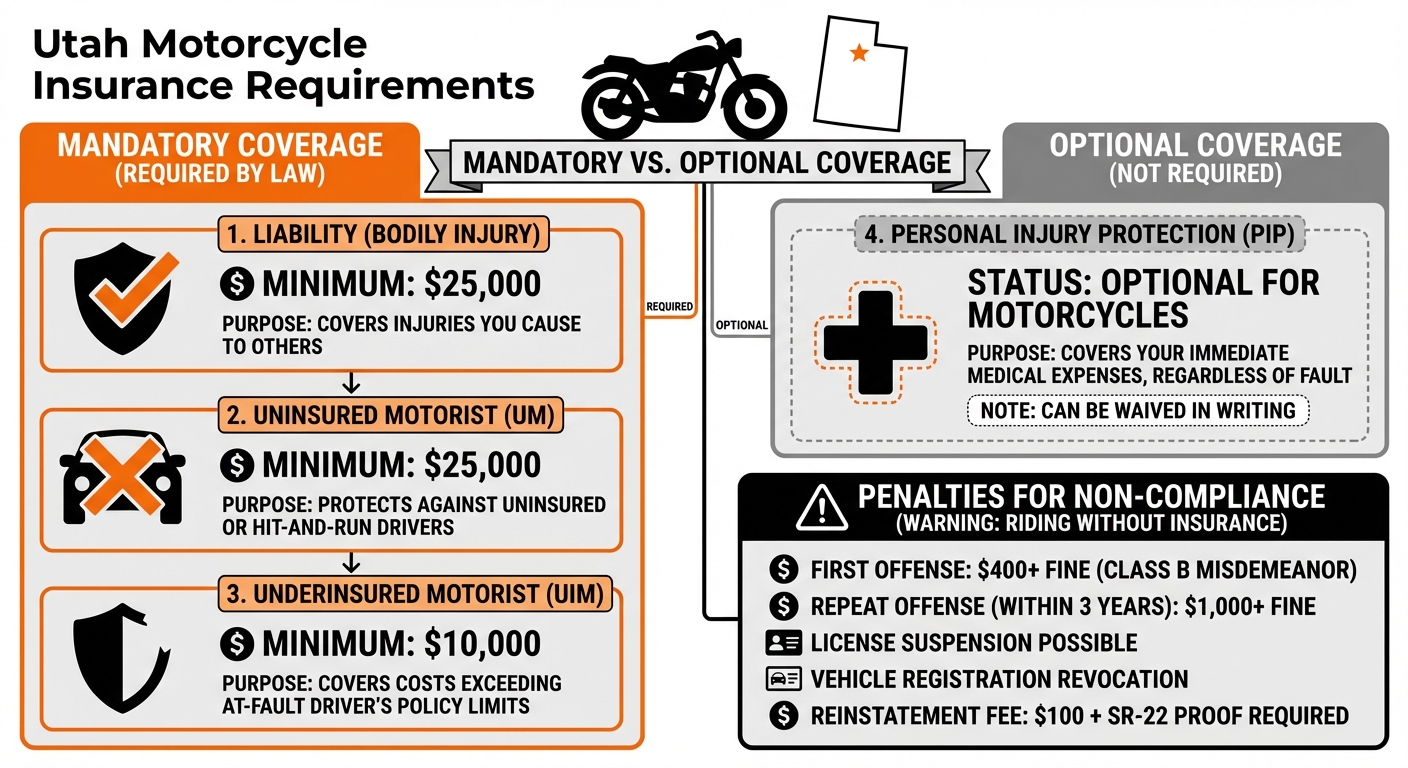
Navigating insurance coverage is a crucial step in the process of filing a motorcycle accident claim in Utah. State law mandates that all motorcycle owners carry liability insurance, which covers damages or injuries they may cause to others in an accident. However, Utah's minimum liability coverage - set at $25,000 - is often insufficient for the severe injuries that are common in motorcycle crashes. For example, initial hospital bills for catastrophic injuries can quickly exceed this amount.
Unlike standard vehicles, Personal Injury Protection (PIP) is optional for motorcycles in Utah. Riders can choose to waive this coverage in writing. Below, we’ll break down the required coverages and additional options that can protect you in case of an accident.
In addition to basic liability insurance, Uninsured Motorist (UM) and Underinsured Motorist (UIM) coverage are often overlooked but incredibly important. UM coverage protects you if you’re hit by an uninsured driver or involved in a hit-and-run. The state minimum for UM coverage is $25,000. UIM coverage, on the other hand, steps in when the at-fault driver’s insurance falls short, with a minimum required limit of $10,000.
While insurance companies may encourage you to waive UIM coverage to save on premiums, doing so can leave you financially vulnerable. Consider these examples:
| Coverage Type | Utah Minimum | Purpose |
|---|---|---|
| Liability (Bodily Injury) | $25,000 | Covers injuries you cause to others |
| Uninsured Motorist (UM) | $25,000 | Protects against uninsured or hit-and-run drivers |
| Underinsured Motorist (UIM) | $10,000 | Covers costs exceeding the at-fault driver’s policy limits |
| Personal Injury Protection (PIP) | Optional | Covers your immediate medical expenses, regardless of fault |
Failing to maintain the required insurance is classified as a Class B misdemeanor in Utah. First-time offenders face fines starting at $400, while repeat offenses within three years result in fines of at least $1,000. Additionally, the Utah Department of Public Safety may suspend your driver’s license, and the DMV can revoke your vehicle registration if insurance lapses are identified through the Insure-Rite database. To reinstate your registration, you’ll need to pay a $100 fee and provide proof of current insurance or an SR-22.
Even with proper coverage, disputes with insurers can arise after an accident, making it essential to understand how to handle such situations.
When accidents involve uninsured or underinsured drivers, your UM/UIM coverage becomes your primary safety net. The first step is to review your policy to confirm your coverage details. For hit-and-run accidents, your UM coverage will also apply.
Insurance companies may attempt to minimize payouts by disputing the severity of your injuries or assigning you more fault than warranted. While your own insurer is expected to act in good faith, disagreements over policy limits or the extent of damages can still occur. This is why having adequate UM/UIM coverage is critical - it shifts the claims process to your own provider when the at-fault party’s insurance is insufficient.
Increasing your UM/UIM limits is usually a cost-effective addition to your liability policy. Given the heightened risks motorcyclists face compared to car occupants, even minor accidents can result in devastating injuries or fatalities for riders. To protect yourself financially, consider purchasing coverage well above the state minimums. Take the time to review your policy now to ensure you haven’t unknowingly signed a waiver that could leave you exposed when you need coverage the most.
Navigating motorcycle accident claims in Utah can be overwhelming, especially for riders without legal representation. Insurance companies often have teams dedicated to reducing payouts, leaving unrepresented riders at a clear disadvantage. The stakes are high - motorcyclists are 13 times more likely to die in a crash compared to occupants of other vehicles. Between 2009 and 2018, motorcycle accidents accounted for 18% of Utah's traffic fatalities, despite making up only 1% of all crashes. Without the guidance of a skilled attorney, securing the compensation you deserve becomes an uphill battle. This makes having the right legal support essential for navigating Utah's complex accident claims process.
Experienced attorneys bring a strategic edge to motorcycle accident cases. They assess the full extent of damages, including future medical costs, lost earning potential, and non-economic losses like pain and suffering - things victims often miss. On average, motorcycle accident victims who go to trial for personal injury claims receive $73,700 nationally, though outcomes depend heavily on how well the case is presented.
Attorneys gather crucial evidence, such as police reports, witness accounts, and Event Data Recorder (EDR) data. They also enlist experts like accident reconstructionists and medical professionals to establish fault and validate the severity of injuries. This is especially important in Utah, where the modified comparative negligence system allows victims to recover damages only if they are less than 50% at fault. Additionally, attorneys handle all communication with insurance companies, ensuring victims aren't pressured into accepting premature or inadequate settlement offers. Beyond maximizing compensation, attorneys streamline the claims process and manage the complexities of insurance negotiations.
Unlike car accident cases, motorcycle claims in Utah bypass the $3,000 Personal Injury Protection (PIP) threshold, allowing riders to file lawsuits for damages right away.
True North Injury Law stands out with a proven track record in handling motorcycle accident cases. With over 10 years of experience, the firm has recovered more than $15 million for clients and assisted over 500 individuals. They operate on a contingency fee basis - meaning you owe nothing unless they win your case.
Lead attorney Jake Lee is known for providing personal attention throughout the recovery process. As one client, Jesse Dean, shared:
Jake was there for us through every surgery, every doctor appointment, and even physical therapy sessions he would check in and make sure we were recovering and getting the care we needed.
True North Injury Law has secured notable settlements, including $350,000 and $200,000 for motorcycle accident cases, $553,000 for a brain injury case, and $400,000 for a spine injury.
The firm also offers free consultations to assess your case with no obligation. Considering Utah's four-year statute of limitations for filing motorcycle accident claims, reaching out to an attorney quickly is critical to preserving evidence and protecting your rights.
Utah's motorcycle accident laws are designed to protect riders and ensure fair compensation when accidents occur. For instance, while riders aged 21 and older can choose not to wear helmets, insurance companies may lower compensation for injuries if a helmet wasn't used. Utah follows a modified comparative negligence system, meaning you can only recover damages if you're less than 50% at fault. However, any compensation will be reduced by your percentage of responsibility. The state also enforces minimum liability insurance limits to safeguard everyone involved. Additionally, lane filtering is allowed under specific conditions: traffic must be stopped, the speed limit must be 45 mph or less, and motorcyclists must travel at 15 mph or below. Motorcyclists are also entitled to the full use of a lane, and other vehicles are prohibited from encroaching or sharing that space. These legal guidelines are crucial for understanding your rights and responsibilities after an accident.
Beyond knowing the laws, taking immediate and practical steps after an accident is just as important. Preserving evidence, seeking medical attention right away, and avoiding any admission of fault can significantly impact your case. It's worth noting that 80% of motorcycle collisions involving other vehicles are not the rider's fault. Unfortunately, insurance adjusters sometimes stereotype motorcyclists as reckless, which can affect how claims are handled.
Because of these challenges, having skilled legal representation is vital. True North Injury Law offers free consultations and works on a contingency basis, meaning they only get paid if you win. Their team fights against insurance bias, ensures all damages (including future costs) are accurately calculated, and handles the complexities of Utah's comparative fault system to help maximize your payout. Considering that motorcyclists are 13 times more likely to be killed in crashes compared to occupants of other vehicles, having an experienced attorney on your side can be the difference between a fair settlement and an insufficient one.
To show you were less than 50% at fault in Utah, you'll need to collect solid evidence such as eyewitness statements, accident reports, and expert testimony. Under Utah’s modified comparative negligence rule, you can recover damages as long as your fault is determined to be below 50%. Since courts evaluate and compare fault levels, it’s essential to dispute any unfair fault assignments and back up your claims with convincing evidence.
To back up your claim, make sure to gather these key pieces of evidence at the crash site:
Always put safety first and ensure medical needs are addressed before you begin documenting the scene.
Not wearing a helmet doesn’t automatically mean your settlement will be reduced, but it could influence how negligence is viewed in your case. In Utah, this might also affect the damages you’re awarded, depending on the laws and the specifics of your situation. It’s always a good idea to consult a legal expert to fully understand how this could play out in your case.

